


Before you sign your first contract with a fenestration manufacturer, it is worth knowing what to expect. Not just to avoid unpleasant surprises—because they happen in any B2B partnership—but so you can distinguish between the norm and a red flag.
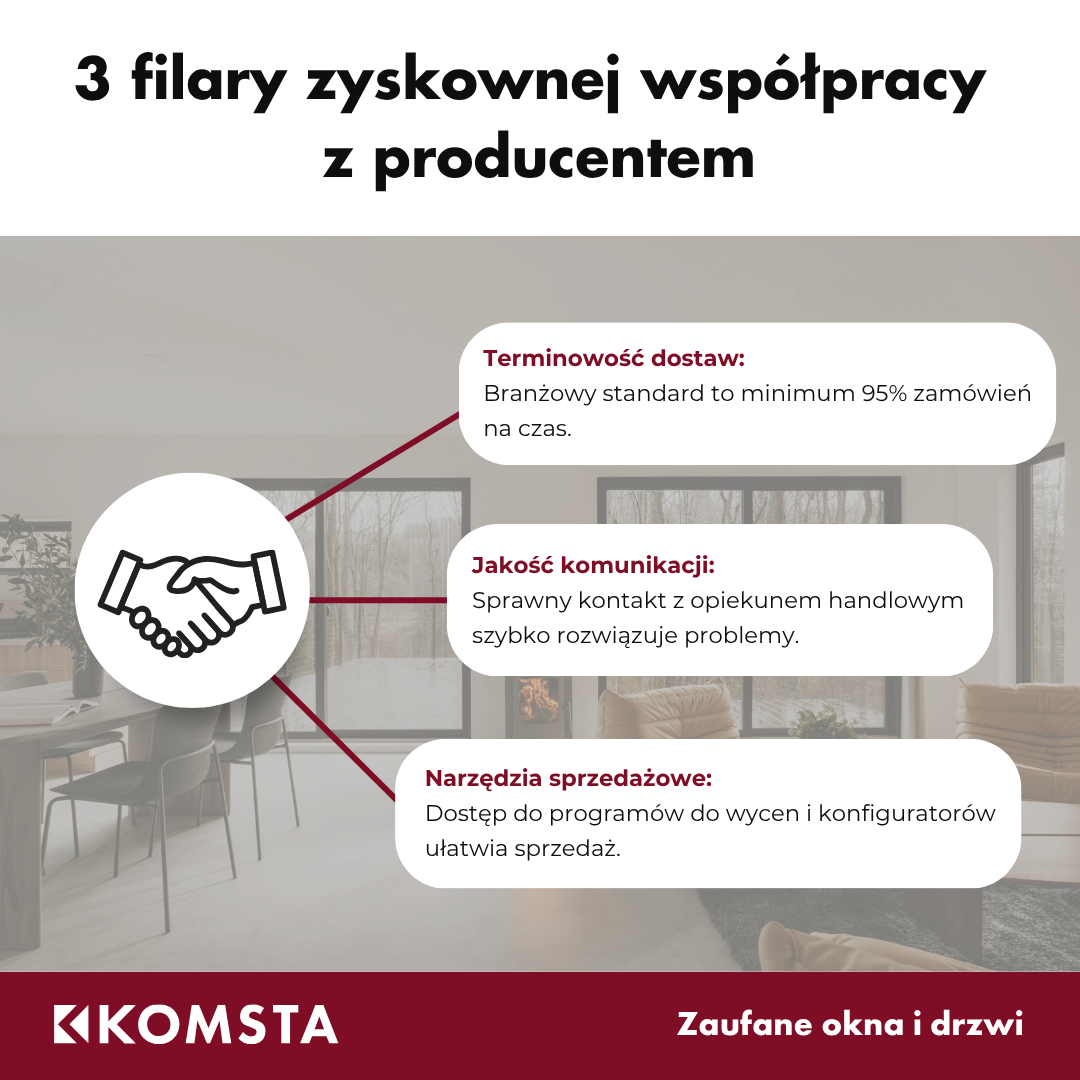
The collaboration between a distributor and a manufacturer follows a recurring cycle: quote → order → production → delivery → service. It sounds simple. In practice, between the first conversation and the first completed order, it takes on average from 1 to 6 months, and sometimes even longer if necessary. Three things determine whether a business partnership will be profitable for years to come: delivery reliability (the industry benchmark is a minimum of 95% of orders delivered on time – ours is 96%), the quality of communication with your account manager and the availability of sales tools that actually help you sell.
This article is for you if you are looking for a fenestration manufacturer and want to know what the collaboration looks like from the inside. It will also be useful if you already have a supplier but your relationship is not ideal, and you are wondering if this is the norm or if it is worth comparing other offers. It will also be valuable for those who have already had several conversations with window and door manufacturers and want to understand which questions are truly worth asking.
Before we dive into the stages of cooperation, let’s clear things up: the terms "distributor," "dealer," and "installer" are often used interchangeably in the industry, but they are not synonyms. Distinguishing between them is crucial, especially when setting commercial terms within a fenestration distribution network.
A distributor is a company or individual that purchases windows and doors from a manufacturer at wholesale prices and resells them to end customers or smaller retail outlets in their territory. They may operate on a stock-based model, keeping a certain amount of inventory on hand, or order exclusively for specific customer projects. The latter model is far more common in the fenestration industry, as products are almost always custom-made. A distributor typically has their own showroom, employs sales staff, and maintains direct contact with investors.
A dealer is a term used by some manufacturers as a synonym for a distributor, but in a narrower sense, it refers to an entity operating within a limited territory, often without the right to resell, and focused exclusively on retail sales. Commercial terms for a dealer are usually less favorable than for a distributor, as they are not expected to generate the same high volumes.
An installer, on the other hand, is a specialist in fenestration installation. They may purchase from a distributor or have a direct contract with a window and door manufacturer if they handle sufficiently large projects. Some installers also act as distributors for their region.
In practice, manufacturers differentiate commercial terms for distributors based on the cooperation model and purchase volume. If you consider yourself a distributor, it is worth communicating this clearly from the start. This affects discount thresholds, payment terms, and the level of support you receive through a partner program. The scale of such networks can be significant—for example, the Komsta distribution network includes around 200 retail points.
Some distributors come to a manufacturer right at the start of their journey, as new companies entering the fenestration industry, and stay for years. Others have already spent years working with a single supplier and eventually start looking for an alternative. To be clear: both scenarios are very common in the industry, and neither is better or worse than the other. What matters is the quality of the partnership.
If you are just entering the industry – the catalyst for finding a manufacturer is usually identifying a local niche, such as noticing that demand for fenestration in your region is high, while service is poor or non-existent. Some new distributors come with experience in related fields: construction, finishing materials, or renovations. They know how to sell technical products and how to talk to investors. They are simply looking for a good window and door supplier.
If you already have a supplier – the signs that a partnership is heading in the wrong direction usually build up gradually. A distributor rarely switches manufacturers after a single incident. The most common reasons that ultimately lead to seeking a new joinery supplier include: chronic issues with delivery timelines (delays that impact your customer relationships), a lack of communication flexibility (long response times to inquiries, difficulty reaching your account manager), outdated window quoting tools that slow down your work, poor handling of complaints (waiting weeks for decisions, lack of concrete feedback), and a general feeling that you are treated as just a number in the system rather than a valued business partner.
The turning point for making a change varies. For some, it is a situation where a client files a serious complaint and the manufacturer fails to address it for months. For others, it is the moment when a competing company in the region partners with a better supplier and starts offering customers something you cannot. For others still, it may simply be exhaustion from a lack of reliable communication.
The best time to switch fenestration manufacturers is when you still have time to calmly onboard a new supplier, rather than when you are backed into a corner by current orders. Changing manufacturers in the middle of the season, when you have a backlog of orders, carries significant logistical risk and causes a great deal of stress.
Before you call anyone or fill out a contact form, it is worth doing a few things on your own. Being well-prepared before your first conversation with a manufacturer ensures that the discussion is substantive from the very beginning, which in turn allows you to quickly assess whether it is worth pursuing further talks and a potential partnership.
The first thing most distributors do when looking for a manufacturer is use a search engine. Phrases like "PVC window manufacturer wholesale," "steel door manufacturer for distributors," or "window manufacturer B2B" will provide a list of companies that are actively seeking trade partners and building sales networks. However, it is worth going directly to the company's website to check if they have a dedicated offer for distributors, as this is a sign that the manufacturer is intentionally building a joinery distribution network and has experience working with partners.
Industry trade fairs, such as Budma in Poznań, are places where you can talk to several manufacturers in a single day, see the products in person, and evaluate how a company compares to its competition. Many long-term partnerships began with a conversation at a trade fair booth.
Recommendations are very powerful in this industry. If you know someone in the construction or renovation sector who has a good joinery supplier, ask them directly: what they like, what they would change about the partnership, and why they chose that manufacturer over others.
Before your first contact with a new supplier, check the following first: how large the company's production facility is (whether it is a micro-factory or a regional or national-scale manufacturer), what profile systems they offer (PVC, aluminum – it is worth checking if they meet your sales needs), what their publicly stated lead times are, and whether the company has a dedicated section for distributors or B2B clients on its website.
To illustrate what an established manufacturer looks like: Komsta has been operating since 1992 (over 30 years) and employs more than 200 people. It works with recognized PVC profile systems (Veka, Aluplast, Gealan, Decco) and aluminum (Aliplast, Aluprof, Aluron), uses Winkhaus, GU, Roto, and Siegenia hardware and Press Glass glazing, and incorporates solutions from brands like Gerda for its doors. It offers products in three price tiers – economy, mid-range, and premium – allowing you to tailor a relevant offer for different types of customers.
The first contact is the moment you transition from reading about a company to speaking with a person. A lot depends on how that conversation goes. On one side, there is a potential business partner evaluating you, but on the other, there is you, evaluating the company you are speaking with.
In the joinery industry, the first contact usually takes place by phone or via a contact form on the website. Sometimes it happens via email initiated by the customer, but that model is more common in other sectors. In this industry, voice calls are the norm. This is simply due to the nature of the product: windows and doors are not items that can be described in a single line. Every answer to a question leads to a series of follow-up questions.
An important point at this stage: who responds to your inquiry? In a well-organized manufacturing company, the first contact from a potential distributor does not go to a call center or reception. It goes to a dedicated sales representative for distributors, or to someone who immediately directs you to the right person. If you wait several days for a callback or your inquiry gets lost in an inbox, that alone may tell you everything you need to know about how the company operates.
Ask specific questions during your first meeting. What are the current lead times? How does the window and door pricing system work? Does the company use its own transport or a shipping carrier? What is the minimum order threshold? What do I need to prepare to place my first order? What is the manufacturer's claims process? A good sales representative will answer these questions directly, or tell you they need to check and will call you back. Vague answers, avoiding specifics, or immediately pivoting to how great the company is are all red flags.
● Concrete, quick answers to questions,
● The feeling that they are talking to someone who knows the product and the industry,
● Availability of samples and demonstration materials,
● Clear information on the next steps for establishing a partnership – step by step.
● Long wait times for a response,
● Unclear communication regarding trade terms and deadlines,
● A lack of interest in what you – as a distributor – actually need.
The time from initial contact to the decision to partner varies significantly. If a distributor knows what they want and can make a quick decision, it might take a few weeks. If they want to compare several manufacturers' offers, conduct product tests, and consult the terms with their accounting department, it could take several months. A manufacturer who understands this decision-making process will not pressure you.
Before placing your first order, you need to have clarity on a few key points. The more of these that are agreed upon in writing before starting the partnership, the fewer misunderstandings will arise later.
Typical issues to settle before the first order include:
● wholesale price lists and discount tiers (usually dependent on volume or the type of partnership),
● payment terms (standard bank transfer, or potentially trade credit for established partners),
● minimum order values (or lack thereof – this depends on the manufacturer's policy),
● delivery terms and associated costs,
● territorial exclusivity within the distribution network – whether the manufacturer works with other distributors in your region and under what terms.
The negotiable elements of trade terms depend on the bargaining power of both parties. For a new, unknown distributor, the starting margin will usually be standard. The opportunity for renegotiation arises once you have proven your volume over several quarters. For someone coming in with an existing client portfolio and high turnover from a previous supplier, the room for negotiation is significantly wider.
Trade agreements with window and door manufacturers take various forms. Some manufacturers use standard, uniform contracts with minimal room for modification. Others take a more flexible approach, tailoring provisions to a partner's specific situation. Increasingly, instead of a formal contract, distributors simply accept the general terms of sale. This model is logistically simpler but requires greater attention when reading the document.
Issues that most frequently raise questions for distributors at this stage are: liability for damage during the transport of joinery (who owns the goods during transit?), complaint procedures during the first year of cooperation and how pricing changes over time – whether the manufacturer provides advance notice of price adjustments. It is also worth asking about the warranty period and the possibility of extending it – Komsta offers warranty extensions of up to 10 years.
If the manufacturer offers different partnership tiers or a partner program for distributors, it is worth asking about the specific criteria for advancement. What sales volumes are required to access better terms? What responsibilities are associated with a higher partnership level?
Signing the cooperation agreement is not the end of the onboarding process. It is merely the beginning. Between signing the contract and the first successful customer transaction, there is usually a period of anywhere from a few weeks to a few months. This time is a one-time investment, and it is worth planning it carefully.
The first step is usually gaining access to the quoting system. A modern joinery manufacturer provides the distributor with a dedicated B2B program or application where they can independently price windows and doors according to the current wholesale price list. Learning such a program takes—with active use—between one and several days. Good systems feature an intuitive interface, built-in prompts, and the ability to generate customer quotes with the distributor's logo. In advanced systems, once a quote is accepted, the order can be placed with literally one click. Poor systems require long training sessions, have non-intuitive navigation, and cannot be customized to the needs of a specific company.
The manufacturer should provide product training on how to use the system, either in person at their facility or online via webinars or video recordings. It is worth asking in advance how this works: is the training a one-time event, can you revisit the materials, and is there a dedicated support person available after the training for any follow-up questions?
Sales materials that a distributor should receive at the start include:
● current product catalogs and brochures (ideal as PDFs to send to customers, but also in printed versions for your showroom),
● color and veneer swatches,
● samples of hardware and accessories for windows and doors, and where possible, cross-section samples of profiles and glass units,
● showroom equipment with display windows at preferential rates,
● software for preparing quotes,
● technical support during the implementation of the quoting software.
Some manufacturers make these materials available for self-download – you can find our catalogs, specifications, and documents in the "Downloads"
For door systems, dedicated online door configurators are becoming increasingly common, allowing customers to see what their chosen door configuration will look like. A good manufacturer provides such a configurator to the distributor with branding options, so it can be used when interacting with your own customers. We provide our own Door Configurator (available online since 2022).
A separate issue is showroom display. If you have your own showroom, it is worth asking the manufacturer for support in building your display, such as demo models at preferential prices or for rent. A well-planned joinery display sells for you: the customer sees the product at a 1:1 scale, can check the quality of the hardware, and feel the weight of the door leaf.
What usually takes the most time when onboarding a new distributor? In practice, it’s not learning the software or browsing catalogs. The most time-consuming part is the mental preparation required to sell a specific product: understanding what sets a brand apart from the competition, knowing which arguments to use when comparing offers, and learning how to handle tough questions from end customers.
Once the formalities are settled and you understand how the B2B system works, the reality of daily cooperation with the manufacturer begins. It looks roughly the same for every customer who walks through your door.
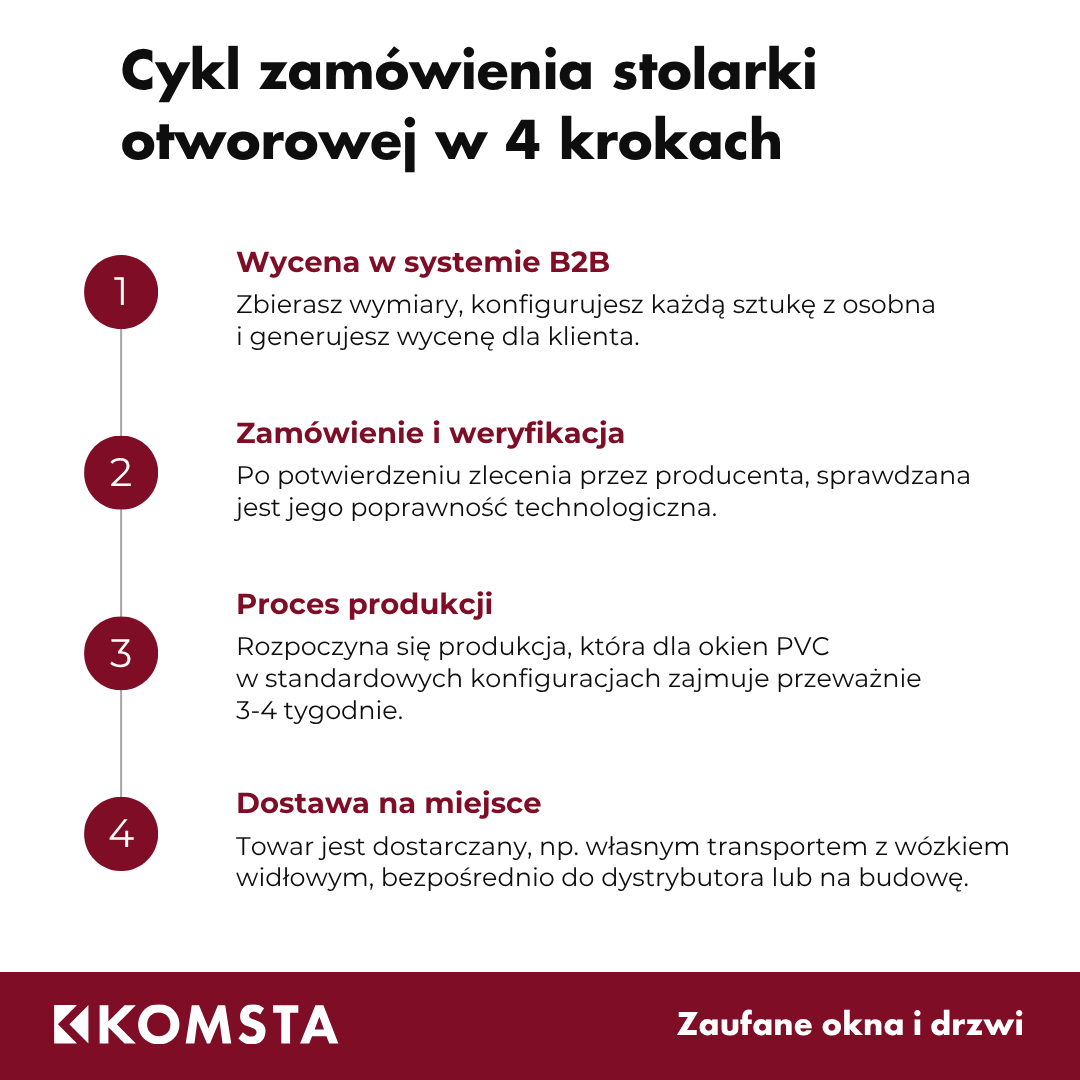
A customer comes to you with a need: replacing windows throughout their house, new apartment doors, or a garage door. Your task at this stage is to take measurements, determine preferences, and select the right product from the manufacturer's range. At this point, you log into the B2B system, configure each item individually (since joinery is almost always custom-made), and generate a quote. A good window quoting system lets you do this quickly. You export the quote as a PDF with your logo and present it to the customer.
If the customer accepts the offer, you place the order. Once the manufacturer confirms the order, production begins. It is worth asking whether the manufacturer verifies the technical accuracy of the order before production starts – Komsta checks the design and warns the distributor about potential issues before a faulty product reaches the customer, which reduces future complaints.
Lead time is one of the most important factors when choosing a manufacturer and a primary reason for switching suppliers when things go wrong. Standard industry production times are 3-4 weeks for PVC windows and 5-6 weeks for custom doors or non-standard structures and solutions. However, these lead times can extend during the peak construction season. A good manufacturer informs you about this in advance and does not hide delays. The worst-case scenario for a distributor is when the deadline has passed, the customer calls to ask, and you don't know what to say because the manufacturer hasn't updated the order status.
The delivery of joinery can vary depending on the manufacturer and their logistics model. Some manufacturers deliver using their own transport to a specified address: the distributor's warehouse, the construction site, or directly to the end customer. Others use logistics partners. Komsta delivers using its own transport – since 2018, they have operated trucks equipped with forklifts – directly to the specified address, including construction sites, with an unloading option.
It is worth asking about a few things:
● what the delivery range is (whether the manufacturer covers the entire country or only specific regions),
● whether delivery directly to the construction site is possible (which saves one stage of reloading and is very convenient for the investor),
● who is responsible for any damage during transport,
● what the acceptance protocol looks like.
A good manufacturer ensures delivery. The driver assists with unloading by using a forklift attached to the truck. Complete documentation is provided with the goods: approvals, certificates, and a warranty card. Orders are properly labeled and packed so that each piece is easy to identify at the installation site.
No one plans for complaints. However, anyone who has been selling joinery long enough knows that they happen. How a manufacturer handles complaints is one of the most important indicators of the quality of a business partnership.
A complaint in the joinery industry can arise from several causes: material or production defects (glass defects, scratches on PVC or aluminum profiles, incorrect hardware), measurement errors (incorrect dimensions despite a correctly placed order), shipping damage or – as sometimes happens – an error made during installation or while in use. It is worth distinguishing between these cases, as the liability of the manufacturer differs from that of the distributor or installer.
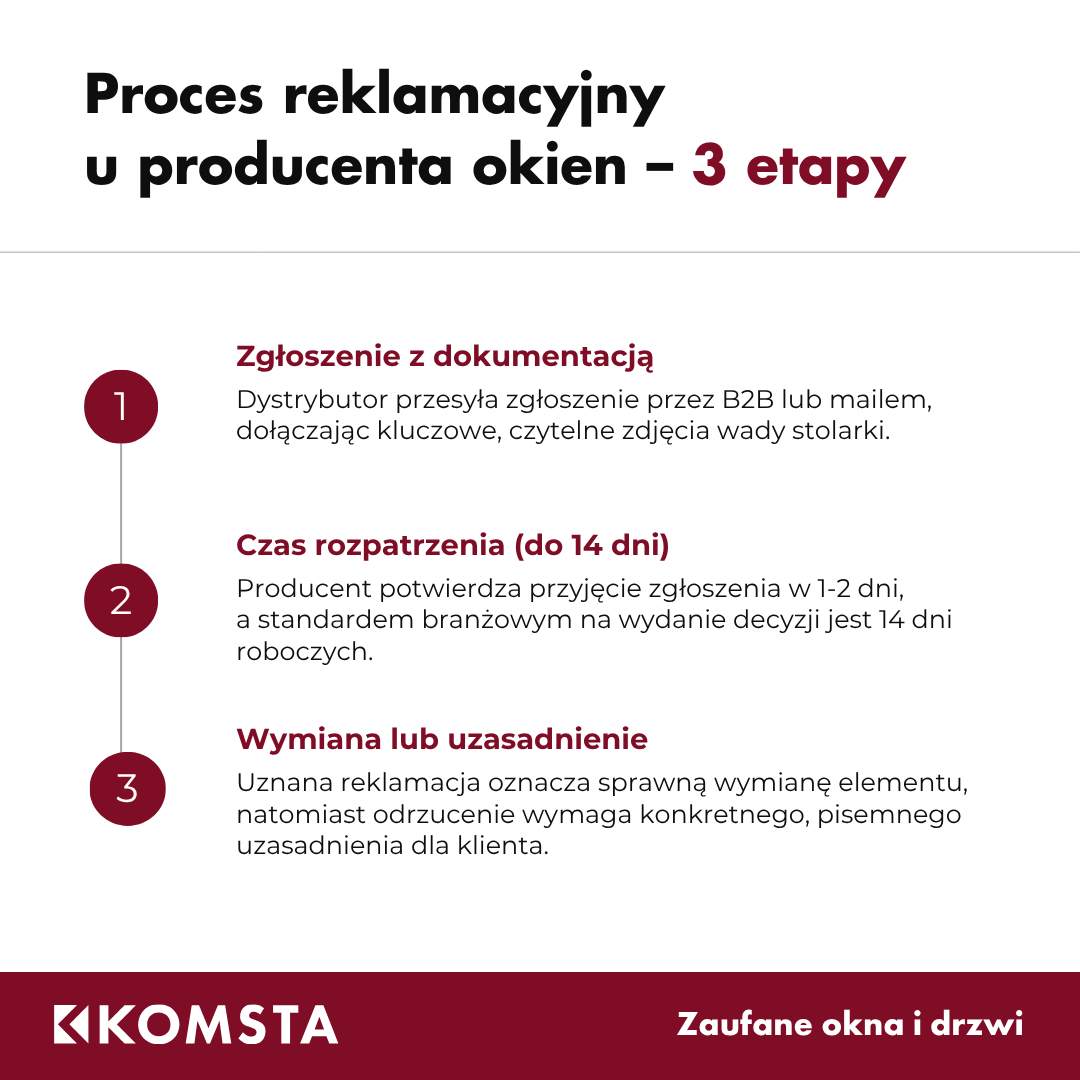
1. The distributor submits a complaint to their account manager – usually via email or through the B2B system, with photographic documentation attached. Documentation is key: the clearer the photos of the defect, the faster the complaint can be processed.
2. After submission, the manufacturer should confirm receipt of the complaint within 1–2 business days and inform you of the estimated processing time. The time taken to process a complaint is another indicator of a window manufacturer's quality. The industry standard is 14 business days. Complaints that drag on for months without any concrete response are a sign of a systemic problem, either within the manufacturer's organization or in how the company treats its business partners.
3. If the complaint is accepted: the manufacturer replaces the defective component or product within an agreed timeframe. If it is rejected: a written explanation with specific justification should be provided – so that you, as a distributor, can explain it to your client. A situation where a complaint is rejected without providing a reason is unacceptable in professional B2B cooperation.
Two factors shorten our repair turnaround time: in-house glass production and a mobile service team. Once a complaint is approved, we manufacture the new glass pane within 24 hours - this timeframe applies to the production of the glass itself, not the entire repair process. The replacement is then carried out by our mobile service team directly at the end customer's location, at a time agreed upon individually.
Good complaint handling doesn't eliminate problems, but it ensures they don't destroy relationships. A customer who has experienced a quick and efficient resolution to a joinery issue often becomes more loyal than one who has never encountered any problems at all.
A good window and door manufacturer is more than just a factory that supplies you with goods. They are a business partner that wants you to sell, because their results depend on yours. It is worth knowing what kind of support you can expect and what to ask when choosing a joinery supplier.
Sales tools are the foundation of any efficient partnership. The basis is, of course, software for pricing windows and doors. It should be up-to-date, intuitive, and allow you to generate quotes with your own logo. More and more manufacturers are also offering an online door configurator. A distributor can use it in the showroom directly with the customer, and the customer can see on the screen exactly how their door will look in the chosen color and hardware configuration. This is a real sales tool that shortens the decision-making process and increases conversion.
Marketing materials should be tailored for practical use, not just for display at industry conferences. Useful items include: PDF product catalogs (for emailing and printing), high-resolution product photos (for your website, social media, and sales proposals), color and material samples for your showroom. An increasing number of manufacturers also provide ready-to-use social media content: graphics, stories, and posts for the distributor to publish on their profile. If a manufacturer doesn't offer this, it's worth asking; some companies are happy to do it but don't actively promote the possibility.
Supporting foreign-speaking customers is an aspect worth keeping in mind, especially if you operate in areas with a large population of workers from Ukraine, Germany, or Scandinavian countries. A good joinery manufacturer has materials or communication support prepared in at least English. If your manufacturer operates in European markets, they usually have language resources available that they can also share with you when serving foreign clients. For example, our quotation software generates quotes in seven languages (Polish, English, German, Czech, Slovak, Italian, and Dutch) and in various currencies, and the company itself exports to countries including Germany, Austria, the Czech Republic, Slovakia, Italy, Slovenia, Belgium, the UK, and Scandinavian countries, as well as to Canada and Australia.
Support for local marketing is understood differently by different manufacturers. The minimum level is providing materials with a logo. A higher level includes joint campaigns, co-financing local advertising, support in building a showroom display, and providing sponsored posts. The best business partnerships are those where the manufacturer treats your sales success as their own and actively supports your marketing efforts. In practice, for a manufacturer consciously building a network, the process is often captured in a simple scheme – at Komsta, it is four steps: contact and an individual cooperation offer, completing formalities and training, assistance in organizing the showroom space along with sales support materials, and then joint business development.
Once you are working with a joinery manufacturer, it is worth having a specific list of criteria for evaluating the partnership – things you can measure and compare.
First: on-time order fulfillment. A minimum of 95% of orders delivered on the agreed date. A one-off delay can happen to anyone. A pattern of delays is a systemic problem that will sooner or later hit your customer relationships. Komsta delivers 96% of orders on time.
Second: availability and quality of communication with your account manager. Your account manager picks up the phone, replies to emails the same or next day, and knows your orders instead of treating you like an anonymous customer. If they can't answer, they tell you when they will and they follow through.
Third: predictability of wholesale pricing and trade terms. Price changes are communicated well in advance (at least a few weeks), not overnight. This allows you to plan offers for your customers without the risk of a quote becoming outdated before the customer signs the contract.
Fourth: efficient claims processing. It’s not about never having a claim rejected. It’s about getting a clear, prompt update on the status of every case you report. No response is not a response.
Fifth: tools and materialsthat actually help you sell joinery. An up-to-date price list in the B2B system, the ability to generate quotes for your customers with your own logo, showroom samples, and an online configurator.
● chronic delivery delays without any advance notice,
● difficulty reaching your account manager or the lack of a dedicated one,
● surprise changes to pricing and terms without notification,
● lack of written order confirmations,
● complaints taking months to process or being rejected without justification,
● lack of access to up-to-date marketing materials for distributors.
Any one of these red flags is reason enough to have a conversation with your manufacturer. If you’re seeing several at once, it’s time to look for an alternative in the window and door distribution network.
Distributors who have switched manufacturers and started fresh often say the same thing: the biggest difference was the human connection. Not the certification, not the price per square meter of window, not even the order lead time. The feeling that they have a real partner on the other side who cares about their situation and responds to problems. Our partners confirm this: after six years of cooperation, Oknoteka highlights our fast complaint processing and prompt quote preparation, while PHU Profil, DM Trade, and BEMIX point to our on-time deliveries and accessible technical support.
A partnership between a distributor and a window and door manufacturer is a relationship that, when well-matched, can last for many years and translate into steady sales growth for joinery in your region. However, a good relationship doesn't happen by accident. It comes from consciously going through several stages: assessing your own situation, conducting a thorough search for a manufacturer, making a smart first contact, establishing clear commercial terms, executing a smooth onboarding process, and carefully monitoring day-to-day cooperation.
Key takeaways: Not every manufacturer treats distributors as strategic partners – and this is a matter of approach, not just wholesale pricing. A benchmark worth knowing: at least 95% of orders delivered on time is the industry standard for joinery fulfillment. Sales tools – window and door pricing software, online configurators, and marketing materials – have a direct impact on your results. Ask about them from the very first conversation. Complaints are the true test of a B2B relationship. Do not avoid this topic when choosing a manufacturer. Ask directly how it works. Good cooperation starts with good communication and relies on that same communication.
If you want to learn more about what it’s like to work with Komsta as a joinery manufacturer – a company operating since 1992 (over 30 years), with a team of over 200 people and exports to a dozen European countries, as well as Canada and Australia – check out our business offer or visit the distributor zone (Komsta, ul. Nasienna 2, 44-120 Pyskowice, tel. +48 32 338 36 10).
It depends on the manufacturer. Some companies do not set minimum order values, especially if you operate on a model where you order for specific client projects rather than for stock. Others set thresholds, such as a minimum one-time wholesale order value or a minimum annual turnover that determines access to better trade terms. It is worth asking about this during your first contact with the manufacturer, as policies vary and have a real impact on the profitability of the partnership from the start.
Standard lead times are 3-4 weeks for PVC windows in typical configurations. Doors, aluminum structures, and sliding windows—especially those that are non-standard or made from premium materials—may require 5-6 weeks for production. During the peak construction season, lead times can be longer. A good joinery manufacturer will inform you of this in advance, rather than only after the order deadline has passed.
Some manufacturers offer trade credit to established business partners who have a history of cooperation and documented turnover. At the start of a partnership, prepayment is usually required. While it is worth negotiating the possibility and terms of trade credit, it typically only becomes a realistic option after several months of documented cooperation with the joinery manufacturer.
This depends on the contractual terms and who is organizing the transport. If the manufacturer delivers using their own transport to the specified address, the responsibility for damage incurred in transit usually lies with them, provided that it is properly documented upon delivery. If the goods are collected from the manufacturer by the distributor or an external logistics company, responsibility transfers at the moment of handover. This is a matter that should be clearly regulated in the contract or the manufacturer's general terms and conditions of sale.
The key is proper time management. Avoid changing your joinery supplier during peak season when you have a high volume of orders. Plan for an overlap period: fulfill current orders with your old manufacturer for a few months while simultaneously finalizing the onboarding of the new one and placing your first smaller test orders. You don't need to inform end customers about the change of manufacturer. What matters to them is that their windows and doors are delivered on time and in good quality. Ensure that the change of supplier does not affect any currently placed orders.
Some manufacturers provide color swatches, veneer samples, and demonstration profiles free of charge or for a nominal fee, especially when the distributor commits to a consistent volume of joinery purchases. Display items, such as window or door mock-ups for the showroom, may be available at preferential prices or on a long-term loan basis. It is worth asking about this when discussing the terms of cooperation.
In the vast majority of cases, yes. The manufacturer sets wholesale prices for the distributor, but the retail margin and the final price for the end customer are up to you. Any suggested retail prices that the manufacturer may publish (for example, in catalogs for individual customers) are for guidance only and are not binding for the joinery distributor. Alternatively, the configurator, catalog, or price list may contain retail prices from which the distributor receives a set discount level.
Typically, an active business registration (entry in the CEIDG or KRS), a tax ID (NIP) for invoicing purposes, and—depending on the manufacturer—completing a partner form or signing a commercial agreement for distributors are required. Some joinery manufacturers also check the financial health of a new partner, especially when negotiating trade credit. However, there is no requirement to hold special licenses or certificates to be a window and door distributor, unlike installers, from whom customers increasingly expect installation certifications.


